



Countersunk washer, It is a specially designed fastening component, used in woodworking, metal processing and numerous other applications.
But why use countersunk washers instead of Standard washer? The answer lies in their unique properties, which can perfectly combine structural integrity with aesthetic effect. Hangzhou Shengpeng provides comprehensive knowledge about these versatile hardware components, including their basic functions and advanced selection criteria.
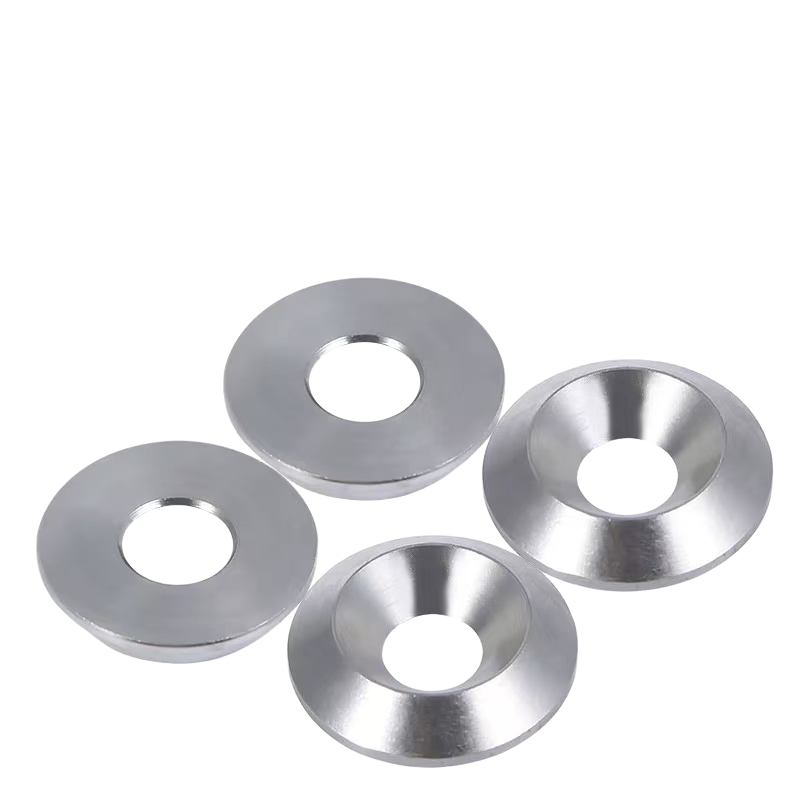
A countersunk washer is a special type of washer characterized by its conical shape. Unlike flat washers, countersunk washers have raised sides, with the central part remaining relatively flat. This unique geometric shape has specific applications: it can form a gradually narrowing seat surface, which perfectly matches the inclined head of flat-head screws or bolts.
When you insert the screw through the countersunk washer, the head of the screw will be embedded in the hole of the washer, resulting in a completely smooth surface. Neither the washer nor the screw will protrude beyond the material surface. The countersunk washer is particularly suitable for applications where attention to appearance is important or where there is a concern that protruding screws might cause entanglement or interference problems.
Countersunk washers are usually made of durable materials such as stainless steel, brass or galvanized steel, which ensures their long-term reliability and resistance to corrosion, rust and wear. They are compatible with various fasteners (including wood screws, machine screws and bolts).
Understanding why use countersunk washer over standard flat washers requires examining their distinct advantages:
The main function of the countersunk washers is to enhance the appearance of the fastening connection. By covering the heads of screws or bolts, they can create a smooth and seamless appearance. When fasteners are used on visible components, the appearance is very important. Standard flat washers would expose the heads of the fasteners. In contrast, countersunk washers achieve this by making the heads of the fasteners flush with the surface.
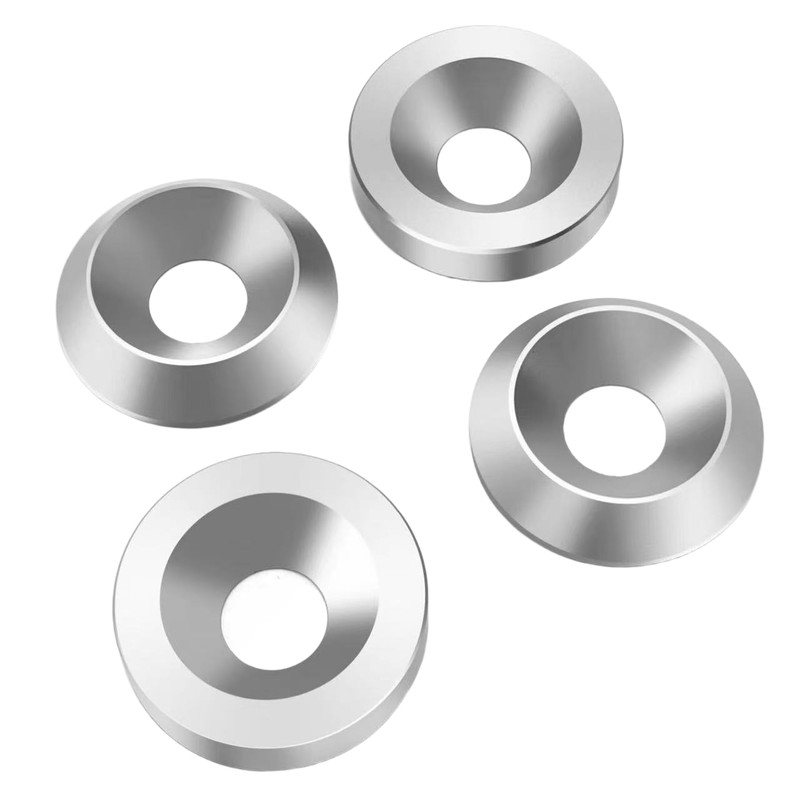
Just like flat washers, countersunk washers can distribute the load more evenly across various surfaces. This load distribution can protect the underlying material from damage.
The countersunk washer performs better than the flat washer in terms of vibration resistance. During installation, it will press against the object being supported and resist vibration by functioning as a spring. By passing a threaded fastener through the central part, the sides of the countersunk washer will contract, exerting pressure on the object. This provides better vibration protection; otherwise, over time, such vibrations may cause the fastener to loosen.
This integrated installation design prevents the heads of fasteners from catching on clothing, materials or other objects passing over the surface. This is particularly important in applications such as floor laying, furniture manufacturing or transportation equipment, where a smooth surface is required to ensure safety and functionality.
For artisans, construction workers, and enthusiasts who enjoy assembling things by themselves, the flush-type washer is an important indicator of the quality of their work.F
Proper installation is crucial for maximizing the effectiveness of the countersunk gasket. Please follow the steps below to achieve the best results:
Preparation and Safety Measures:
Before starting, make sure to prepare all the necessary tools, such as countersunk washers, fasteners, torque wrenches, and any specific tools recommended by the manufacturer. Ensure the working area is clean and well-lit to prevent contamination. Wear appropriate personal protective equipment, such as safety glasses and gloves.
Step-by-Step Installation Guide:
Surface Preparation: First, thoroughly clean the installation surface. Remove any substances that may prevent the gasket from being installed correctly, such as dust, grease or debris.
Alignment: Place the countersunk washer over the pre-drilled hole. The conical side of the washer should face outward so that it can fit perfectly with the countersunk hole. Make sure the angle of the countersunk hole matches that of your fastener.
Fastener Insertion: Select the appropriate fastener for your application. Pass it through the washer and insert it into the hole, making sure it is in the correct position and there is no cross-tightening.
Initial Tightening: Start tightening the fastener with your fingers or a tool. This initial tightening operation helps to properly secure the washer in place and prevents any misalignment during the final tightening process.
Torque Application: Use the torque wrench to tighten the fastener to the torque value specified by the manufacturer. This step is crucial for achieving a secure fastening while avoiding damage to the gasket or the surrounding materials and achieving the optimal balance.
Final Inspection: Once the installation is completed, an appearance inspection is required. The gasket should be fully in contact with the surface without any gaps or protrusions. Additionally, check for any signs of damage or force-induced deformation in the gasket and its surrounding area.
Overtightening: Excessive torque can deform the washer or damage mating surfaces
Improper Alignment: Failing to correctly align the washer results in uneven pressure distribution
Skipping Surface Preparation: Poor cleaning leads to improper seating and reduced effectiveness
Mismatching Components: Ensure washer size and material are compatible with your fastener and application
Selecting the correct size countersunk washer is essential for proper installation.
Note: Currently, there is no set of universally recognized specification requirements for countersunk washer. The following dimensions are only for general reference standards. If you need to meet specific size requirements, please confirm with the supplier.
Screw Size | Outside Diameter (OD) | Inside Diameter (ID) | Overall Height | Typical Application |
#4 | .375" - .334" | .150" - .113" | .103" - .078" | Small electronics, model making |
#6 | .469" - .424" | .200" - .161" | .103" - .078" | Light woodworking, cabinetry |
#8 | .543" - .518" | .220" - .180" | .110" - .086" | Furniture assembly, trim work |
#10 | .606" - .581" | .279" - .235" | .126" - .103" | General woodworking, decking |
#12 | .704" - .656" | .299" - .259" | .138" - .113" | Heavy woodworking, construction |
1/4" | .794" - .762" | .338" - .305" | .156" - .125" | Automotive, light machinery |
5/16" | .938" - .864" | .409" - .373" | .188" - .141" | Medium machinery, structural |
3/8" | 1.125" - .980" | .460" - .425" | .260" - .235" | Heavy equipment, industrial |
Source: Adapted from industry standard measurements
For measurement applications, the common metric specifications include M3 (inner diameter 3.2 millimeters), M4 (inner diameter 4.3 millimeters), M5 (inner diameter 5.3 millimeters), and M6 (inner diameter 6.4 millimeters). Their outer diameters vary from 12 millimeters to 52 millimeters depending on the specific application requirements.
The material and finish of your countersunk washer directly impact its performance, durability, and suitability for specific environments. Here's a comprehensive guide to help you choose:
Material | Strength | Corrosion Resistance | Best Applications | Limitations |
Stainless Steel (18-8) | High | Excellent | Higher cost, work hardening | |
Zinc-Plated Steel | Medium-High | Good | Not for harsh outdoor exposure | |
Brass | Medium | Good | Soft, not for high-load applications | |
Titanium (Grade 2/5) | Very High | Excellent | Very expensive, specialized | |
Black Oxide Steel | Medium-High | Fair | Limited corrosion protection | |
Aluminum | Low-Medium | Good | Soft, limited load capacity |
Key Selection Factors:
Environment: For outdoor or marine use, choose stainless steel or titanium. For indoor applications, zinc-plated steel offers excellent value .
Load Requirements: High-load applications require hardened steel or titanium. Light-duty applications can use standard steel or brass .
Aesthetic Needs: Brass and chrome-plated options provide decorative appeal. Black oxide offers a professional matte finish .
Weight Considerations: Aerospace and racing applications benefit from titanium's exceptional strength-to-weight ratio .
Biocompatibility: Medical applications require titanium or specific stainless steel grades .
When using countersunk washers, it is essential to clearly understand the relationship between them and the processing techniques employed. Counterbore machining and counterbore drilling are two techniques used to create grooves for fasteners, and each technique has its own specific application purposes.
Feature | Countersink | Counterbore |
Shape | Conical (angled) | Cylindrical (flat-bottomed) |
Fastener Type | Flat-head screws, countersunk washers | Socket-head, hex-head, or cap screws |
Angle | Typically 82° or 90° | 90° (flat) |
Purpose | Allows screws/washers to sit flush | Allows bolt heads/nuts to be recessed |
Common Use | Aesthetic applications, woodworking, aerospace | Heavy-duty machinery, industrial equipment |
With Washer | Countersunk washer integrates with countersink | Flat washer sits in counterbore bottom |
When using flat-head screws or fasteners that need to be flush with the surface (such as in aerospace, furniture, and electronic equipment), in applications requiring smoothness.
When it is necessary to reduce stress concentration around the fastener to enhance structural integrity, countersunk washers are specifically designed to fit with countersunk holes, with their conical sides matching the angle of the countersink. For inch-sized fasteners, the standard angle is typically 82°, while for metric fasteners, 90° is used.
Countersunk washers find extensive use across multiple industries due to their unique combination of functionality and aesthetics:
In the fields of cabinet manufacturing and furniture assembly, countersunk washers can prevent the screw heads from penetrating into the cork, while also achieving professional smooth surface treatment. They are crucial for installing cabinet hinges and for the smooth surfaces of visible furniture components.
The applications in the aerospace field require components with high strength, extremely light weight and an absolutely smooth surface, as the smoothness of these parts is of vital importance. Aerospace-grade washer must meet strict requirements in terms of size, materials and performance specifications.
During the vehicle manufacturing and maintenance process, countersunk washers are used to fix the body panels, license plates, and interior decorative parts, and they can make the surfaces present a professional and smooth appearance. They can prevent scratches and keep the visible areas clean and tidy.
Most inch-based flat-head screws use an 82° angle, while metric flat-head screws typically use 90°. Countersunk washers are designed to match these standard angles . Always verify the angle of your fastener before selecting washers.
No. The countersunk washers are specifically designed for flat-head screws. Their conical shape is only applicable to fasteners with corresponding inclined heads.
Yes, they offer better vibration resistance than flat washers. When installed, they act as springs, pushing against the object to resist vibrational loosening .
These terms are often used interchangeably. Finishing washers are countersunk washers designed specifically to provide a clean, finished appearance while distributing load .
Yes. Like all fasteners, they distribute the load of the fastener to protect the underlying material. However, their load-bearing capacity depends on the selected material and size.
Yes, but select appropriate materials. Stainless steel offers excellent corrosion resistance for outdoor use, while standard zinc-plated steel may rust over time .
Use a countersink drill bit that matches the angle of your washer and fastener (typically 82° or 90°). Drill the initial hole for the fastener shank, then use the countersink bit to create the tapered recess .
Currently, there is no single set of requirements accepted as the industry standard for countersunk finishing washers. Always verify dimensions with your supplier for critical applications .
These multi-functional hardware components combine the structural advantages of load distribution with the aesthetic advantage of a completely smooth surface. Whether you are crafting exquisite furniture, assembling aerospace components, or completing DIY projects, countersunk washers can achieve a perfect balance between form and function.
Remember these key points when selecting and using countersunk washers:
Always match the washer angle to your fastener (82° for inch, 90° for metric)
Select materials based on your environment and load requirements
Prepare surfaces thoroughly before installation
Use proper torque to avoid overtightening
Inspect installations to confirm flush seating
By following the guidelines in this comprehensive guide, you'll achieve professional results that stand the test of time while creating smooth, snag-free, attractive surfaces in any application.
Xiaoshan, Hangzhou, Zhejiang, China
carlxu@hardware-sp.com
Mon - Sat: 8AM - 6 PM